Tuesday, November 10, 2015

Specimen #13 Veilwort

Figure 1. Leaves of Pallavicinia lyellii

Figure 2. Cell close up

Figure 3. Costa close up

Name: Pallavicinia lyellii
Common name: Veilwort
Family: Pallaviciniaceae
Collection date: September 14, 2015
Habitat: Dead log
Location: Hiram, OH
Description: "Thalli prostate in thin patches, pale green, thalli 2-6cm long and 4-5cm wide with a central strand. On wet banks along streams and in swamps, Minnesota to Newfoundland South to Florida, Alabama, Mississippi, and Luisiana."

Key used: Concard, H.S.(1956). How to Know the Mosses and Liverworts. WMC. Brown Company.
Keying steps:
1b) Plants Thalloid or, if with stems and leaves, the larger leaves in two rows on the stem and a third row of leaves often present on the underside of the stem, never on the upper side. Rhizoids unicellular, sporophyte short lived.
4b) Plants thalloid or leafy with more than one chloroplast per cell
5a) Plant strongly flattened, thalloid, without distinction between stem and leaf.
6a) Plants with a translucent or transparent thallus, internal tissue homogenous; rhizoids all smooth on internal wall; sporophyte with capsule dividing regularly into 4 valves or dehiscing irregularly and retained in a scam-like structure
7b) Thalli ribbon-shapped, not covered on upper surface with pear-shaped sacs; capsules regularly splitting into four lobes, elater present..pg. 238 Metzgeriales

Metzgeriales
1b) Plants thallouse of shallowly lobed
2b) Margins of thallus wavy or even, but not shallowly lobed
3a) Midrib wel defined, bulging like a cord along lower side of plant, rest of thallus only 1 cell thick
4b) Plant 3-4mm wide, often irregularly wavy; sex organs on oppressed along midrib
5a) midrib with a central strand of small, thick-walled cells. 

Links:
http://www.bbsfieldguide.org.uk/sites/default/files/pdfs/liverworts/Pallavicinia_lyellii.pdf
http://hiddenforest.co.nz/bryophytes/liverworts/leafy/pallaviciniaceae/palla01.htm

Specimen #12 Powder Gun Moss

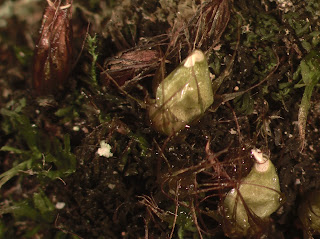
Figure 1. Spore pods

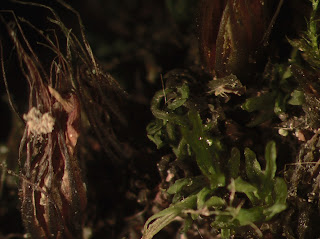
Figure 2. Leaf close up

Name: Diphyscium foliosum
Common name: Powder Gun Moss
Family: Buxbaumiaceae
Collection date: September 14, 2015
Habitat: Found on a moist bank next to a river
Location: Hiram, OH
Description: Spores are in pods that shoot them out when conditions are favorable. Leaves are tongue shaped.

Key used: McKnight, Karl B. and Rohrer, Joseph R. 2013. Common Mosses of the NorthEast and Appalachians. Princeton University Press. New Jersey.
Keying steps:
1b) Leaves arranged in more than two rows and coming out all around stem, wet plants not flat or resembling ferns
6b) Leaves flat or cupped, lacking needle long tip
7a) Plants are ≤1.5cm tall
8b) Leaves with rounded tip capsules 3mm long, shaped like a wheat kernel, stalkless

Links:

Specimen #11 Snakewort

Figure 1. Conocephalum concur found on a rock next to a river 
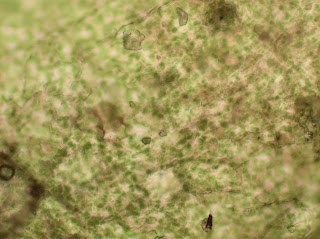
Figure 2. Chloroplast close up

Figure 3. Air pores

Name: Conocephalum conicum
Common name: Snakewort
Family: Conocephaleaceae
Collection date: September 17, 2015
Habitat: Growing on a moist rock next to the river
Location: Chagrin Falls, Ohio
Description: "Thalli  pale to dark green, up to 20cm long and 1-2cm wide. Dichotomously mostly branching, upper surface with distinct polygonal areas, pores distinct, on moist rocks and soil. Widespread in North America."

Key used: Conard, H.S. (1956). How to Know the Mosses and Liverworts. WM C. Brown Company.
Keying steps:
1b) Plants thalloid or, if with stems and leaves, the larger leaves in two rows on the stem and a third row of leaves often present on the underside of the stem, never on upper side. Rhizoids unicellular, sporophyte short lived.
4b) Plants thalloid or leafy, with more than one chloroplast per cell
5a) Plant strongly flattened, thalloid, without distinction between stem and leaf.
6a) Plants with opaque thallus that is divided into an epidermis, loose tissue beneath the epidermis contacting air spaces, and lower solid, parenchyma-like tissue, rhizoids of two kinds, one with smooth wall and one with peg-like thickenings on inner wall...Order: Marchantiales

Pg. 283 Marchantiales
1a) Air pores visible without lens, each in a polygonal area; capsules borne on the underside of an umbrella-shaped receptacle, with spirally banned elaters among spores, walls of capsules with ring-shaped thickenings
8b) Thalli without gamma and without marginal scales on underside
10a) Air pore on a low mound of colorless cells, antheridia in a warty spot on thallus

Links:


Wednesday, October 14, 2015

Specimen #10 Powdery Gold Speck Lichen

Figure 1. Candelariella efflorescens

Name: Candelariella efflorescens
Common name: Powdery Gold Speck Lichen
Family: Candelariaceae
Collection date: September 14, 2015
Habitat: Tree bark
Location: Hiram, Ohio
Description: Crustose yellow surface forming very small round patches. Thallus consists of yellow round, flat patches 0.2mm in diameter. 
Collector: Katie Trushel

Key used:Walewski, Joe. (2007). Lichens of the North Woods. Kollath and Stensas Publishing. Minnesota.
Keying Steps: Trees and crustose section
Notes: Common on maple and aspen trees


Links:

Specimen #9 Common Green Shield Lichen


Figure 1. Flavoparmelia caperata

Figure 2. Close up of Flavoparmelia caperata

Name: Flavoparmelia caperata
Common name: Common Green Shield
Family: Parmeliaceae
Collection date: September 14, 2015
Habitat: Tree bark
Location: Hiram, Ohio
Description: "Foliose pale yellow-green lobes with black lower surface and pale brown under edges, lobes 3-8mm wide." 
Collector: Katie Trushel

Key used: Walewski, Joe. (2007). Lichens of the North Woods. Koliath and Stensas Publishing. Minnesota.
Keying steps:
Tree and Foliose section...pg. 107
Notes: Extremely common and abundant in urban and industrial areas due to atmospheric pollution. Grows on all bark in sun or partial shade.

Links:


Specimen #8 Bird's Nest Fungi

Figure 1. Bird's nest fungi found in the mulch
Figure 2. Close up of the bird's nest 


Figure 3. Close up of the peridioles

Name: Cyathus helenae 
Common name: Bird's Nest fungi
Family: Nidulariaceae
Collection date: September 12, 2015
Habitat: Tree base in the mulch
Location: Newbury, Ohio
Description: mini cups with gray circles that appear like small stones
Collector: Katie Trushel

Key used: Kuo, Michael.(2014.) The Bird's Nest Fungi. http://www.mushroomexpert.com/birdsnests.html
Keying steps:  
1b) Fungus shaped roughly like a cup or goblet that is covered with a "lid" when young (though the lid often disappears quickly); "eggs" held in a nest-like receptacle at maturity.
6b) Outer surface and/or inner surface of nest shaggy, hairy, grooved, or velvety.
10a) Inside surface of nest vertically lined or grooved
11a) Found in temperate North America (from the Gulf Coast northward)
12b) Not completely as above
13a) Nest typically 5-6 mm wide; montane and boreal in distribution.

Links:

Specimen #7 Golden Fern Moss

Figure 1. Tomentum nitens at tree base
Figure 2. Tomentum intense wet leaves with sporophytes 

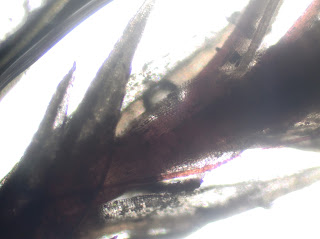
Figure 3. Tomentypnum nitens  brown hairs 

Figure 4. Tomentypnum nitens sporophytes 


Name: Tomentypnum nitens 
Common name: Golden fern moss
Family: Brachytheciaceae
Collection date: September 12, 2015
Habitat: moist tree base
Location: Newbury, Ohio
Description: Dark green in color with stringy branches leaves
Collector: Katie Trushel

Key used:  McKnight, Karl B. and Rohrer, Joseph R. 2013. Common Mosses of the NorthEast and Appalachians. Princeton University Press. New Jersey.
Keying steps:
pleurocarp, lance, costa
1a) plants w/ upright steams, top of plants 3-10cm above substrate
2b) stems pinnately branched nearly to base, thus mimicking an upright feather
5b) plants of wet habitats; stems matted w/ green of red-brown hairs; leaves at stem tips straight
6b) leaves crowded, 3-4mm long

Links: